Newsletter No 45
12 April 2007
Hi.
Whether a fuel-metering device is physical (carburetion) or electronic fuel injection (EFI), manufacturers tend to apply a “lowest common denominator” approach to their generic “out-of-the-box” tune. This helps them get customers up and running quickly (but not exceptionally well) for the majority of applications. The systems are tuned to operate in a wide range of engine combinations, climates and fuel formulations. However, optimal performance doesn’t come from an out-of-the box, generic set-up
Most EFI systems – including the aftermarket “piggyback” or “black box” systems that operate on top of factory Engine Control Units (ECUs) – rely on a basic fuel map for metering fuel. The fuel map is either pre-installed or it requires the user to pull a fuel map calibration down from the EFI system manufacturer’s Web site using their laptop and then upload the fuel map calibration to the EFI system’s Engine Control Unit (ECU) or associated piggyback system. An EFI system’s fuel map can be thought of as a three-dimensional (3D) map of X (Engine RPM), Y ( Load / Throttle Position ) and Z (Fuel Amount to Inject). A similar 3D map applies for spark advance by replacing axis Z’s “Fuel Amount to Inject” with “Degrees of Spark Advance.”
Easy is to stick the car on the Dyno and adjust the Fuel & timing at each specific X and Y.
But even better to put a Data logger on and log everything from basic RPM and Air/Fuel Ratio and Manifold Absolute Pressure (MAP) to more specialized parameters like Throttle Position and Intake Air Temperatures, as well as knock whilst driving on the street or race track.
This will give you exact figures that you can use to manipulate your Efi system with.
A good data logger like mine costs a lot of money but makes working so much sweeter (see the Article at the end).
One of the easiest ways to measure and refine your EFI fuel maps after road testing, is to take your car to a Dyno shop and make many Dyno pulls, being sure to capture the data with logging equipment. Although you may need to rent a few hours to thoroughly tackle all the ranges, a couple of hundred dollars is far less expensive than replacing an engine.
Where do I stop with giving advice ?
I sell Stand-alone and aftermarket Fuel Injection systems.
This should assume that I understand the basics of the 4-stroke internal combustion engine and the rudimentary of Efi J
But does that mean that I have to give advice to everybody whose cars hesitates, jerks or makes too little power ?
I have no problem in helping out, but if that comes as an expense to my paying customers or has me working late into the night because….
Please check out my list of Headers (Branches) and the latest additions. The latest are maybe not necessarily that but often also some weird ones.
We are now
the stockists of:
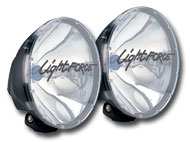
Lightforce Spotlights
• Polycarbonate (Stronger than Metal) Construction
• Shatterproof Lens
• The Only Variable Focus Lights for Vehicles
• High Performance Xenophot Bulb
• Computer Designed Parabolic Reflector
• Tough and Versatile Mounting Apparatus
|
Vehicle
Mounted Spotlights |
Designed and
manufactured in Australia, Lightforce have been recognised as being the best
performing and best value driving lights on the market today. |
|
Available models • 240 Blitz: 240mm reflector. 1 million Candela 4104 set • 170 Striker: 170mm reflector. 500,000 Candela 3164 set • 140 Lance: 140mm reflector. 250,000 Candela 2394 set Wiring Harness with Relay etc. 626 Spare 100 w Xhenophot long life
bulbs 100 |
|
These
prices will be valid until May 2007.
To find out
how they compare to other makes, download the Lightforce "Got
A Million" Brochure (40KB)
If you are
in Windhoek on 13/14 April, please visit me at the Standard
Bank Auto Show held
at Wanderers
·
The gates will open for the public at 14h00 on Friday,
13th of April 2007; gates close on Friday at 20h00
·
on Saturday the 14th, open at 09h00
until 18h00
·
Official opening of the Standard Bank Auto Show
by the Minister of Transport at Friday, 14h00
·
Entrance fee of N$10,00 per person; kids under
12 and pensioners are for free.

I found this
interesting, as most people only associate “pinging” with Timing.
Tuning Tip: Detonation "Fingerprints"
[The following is extracted from a forum thread.]
Here's a log. I had never seen this before in this context. The interesting
part is that on this engine the knocking cylinders cause a specific AFR
signature. I suspect the abnormal combustion during knock causes part of the
mixture to not burn at all, causing excess O2 in the exhaust.
This is off a 632 ci Ford drag racing engine with one 1150 CFM Holley 4 barrel.
The engine came from the builder with 36 deg. of ignition timing. The engine
was designed to run with a 400 HP shot of NOS. Engine was dynoed on a DTS Dyno
equipped with a Broad band Lambda sensor and logging equipment. Ignition timing
was adjusted anywhere from 28 to 36 degrees. Engine made 850 HP at 36 degrees
Ignition timing on VP C16 fuel no NOS.
The engine did not knock audibly, but was not making the expected power. The
first session in the log (named "Detonation 36 deg Advance") is with
C16 fuel and 36 deg. advance. Notice cylinder number 1 and 2 (purple and black)
showing lean spikes, but not the characteristic sharp spikes of ign. misses,
but a lean area with overlaying wild excursions. These cylinders are knocking,
badly, as was determined later.
The last session (named "Session Normal 28 deg") was on C16 with ign.
advance at 28 degrees. NO changes in fueling at all. In that run the engine
made 970 hp (no NOS), a 120 hp gain compared to 36 advance. Because the engine
owner insisted that he needs more timing to make more power, different things
were tried. The second session is with 32 deg timing and cam retarded 4 deg on
Sunoco 118. The lean excursions on Cyl1 and 2 look almost the same as in the
first session if you overlay the two. The third session was with 32 deg. and
Sunoco 118 and cam reset to spec. It looks normal but had less power.
In the end the engine was dialed in with 28 deg. advance. With NOS it made 1450 hp.
Again, the fascinating part is that knock can have such a large effect on AFR data when seen on a cylinder by cylinder basis. When using the WB in the collector the effects will be of course diminished as the lean gas will be diluted by other cylinders normal gas. This dilution would make it harder to see. But when you see sudden lean areas that are not typical spikes from ignition misses and can't be explained by carb/injection events, high speed knock is something to consider. This is especially true for engines with factory knock sensors, as most factory ECUs don't listen to knock sensors above ~4k RPM anyway because engine noise masks the signal too much.
As an additional note, the owner had already blown up two
engines at the track. He didn't believe that datalogging and testing on the
track is necessary because the engine was dialed in on the Dyno already. After
this dyno-tuning session, he proceeded to blow up another one. He now
understands that there are vehicle issues (intake dynamics, fuel delivery,
etc.) that need to be tuned at the track."
Until next time... Keep On Tuning!